
Hydrogen Myths & Facts
By debunking common myths, we can better appreciate the role hydrogen fuel can play in addressing global energy and environmental challenges.

As the world seeks sustainable alternatives to fossil fuels, hydrogen fuel has emerged as a promising option in the transition to cleaner energy. However, like many emerging technologies, hydrogen is surrounded by myths and misconceptions that can hinder its adoption and development.
Understanding the facts about hydrogen is crucial not only for informed decision-making but also for recognizing its potential to contribute to a more sustainable, secure, and energy-efficient future.
Myth 1: “Hydrogen fuel is dangerous and unstable.”
That’s overstated. While hydrogen is highly flammable, so are all useful fuels. When handled properly, hydrogen is not more dangerous than other fuels. In fact, it can be safer than other fuels like gasoline or natural gas as modern hydrogen storage and fueling/dispensing technologies have demonstrated. These technologies have been designed with safety as a key priority, including robust containers and leak detection systems.
Myth 2: “Hydrogen fuel cells are less efficient than combustion engines.”
That’s a myth. Hydrogen fuel cells are actually much more efficient than combustion engines, especially the internal combustion engine (ICE) in most passenger cars. As can be shown by a rigorous thermodynamic analysis, while traditional gasoline (internal combustion) engines typically operate at around 25% efficiency. On the other hand, hydrogen fuel cells can achieve efficiencies of 50-60% and beyond, meaning more of the energy from the hydrogen fuel is converted into usable power/work, which translates to more miles driven.
Myth 3: “Hydrogen Fuel is not environmentally friendly.”
That’s overstated. Hydrogen can be a very clean fuel, and help to drive overall emissions out of our energy system, especially when it is produced using renewable energy sources like wind or solar power (so called “green” htydrogen). Moreover, when used in a fuel cell, the only byproduct is water vapor, making it an environmentally friendly alternative to fossil fuels.
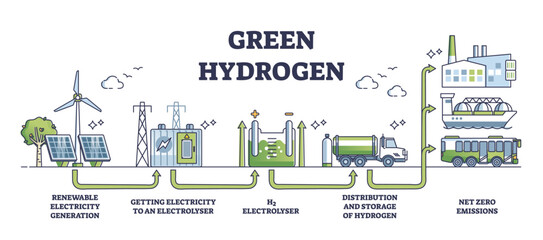
However, it is true that the environmental impact of using hydrogen depends on how the hydrogen is produced, and how it’s used. If derived from natural gas or coal without carbon capture (“grey/brown” hydrogen), it will contribute to greenhouse gas emissions.
Myth 4: “Hydrogen is a significant warming risk.”
That’s misleading. While there are emerging studies that present scenarios of leaked hydrogen contributing significantly to climate warming, these are being misinterpreted. It is true that hydrogen leaked into the atmosphere at any point in the supply chain can have adverse effects: (1) It can act as an indirect greenhouse gas by reacting with other substances in the atmosphere and therefore extending the lifetime of strong pollutants like methane. (2) Leaked hydrogen can also impact ozone concentrations, potentially harming air quality and the recovery of the ozone layer. (3) It can create water vapor in the atmosphere, enhancing the greenhouse gas effect.
However, even at high rates of leakage, green hydrogen has an undeniably overall positive climate benefit in the short- and long-term, especially compared to the demonstrably large climate harm from the fossil fuels it replaces across the supply chain (Exhibit 3).

Exhibit 3: Hydrogen’s emissions impacts along the supply chain are less than those of natural gas, given the large and highly variable upstream methane emissions of natural gas. Crucially, as a carbon-free fuel, hydrogen eliminates all CO2e emissions seen from combustion of fossil fuels.
Even in an improbable non-regulated alternative reality with high leakage rates, hydrogen is still beneficial in our race to decarbonize. Blue hydrogen will provide advantages over its unabated fossil fuel alternatives, but its climate alignment remains more uncertain than that of green hydrogen, given the significant emissions risks from methane leakage, onsite capture efficiency, and permeance of storage.
Developing robust leak prevention technologies through improved connectors, compressors, and storage vessels will enable new systems to be nearly leak-proof, and reliable and cost-effective leak detectors will be important to deploy at scale. Producers are already proactive about minimizing and detecting leakage from a safety perspective, but these measurement techniques are more rudimentary and designed to limit ignition risk. More sensitive detectors to monitor small leakage volumes are available, however. Incentives to support wide-scale measurement and reduction of leakage will bolster investment in such technologies as the global race to scale hydrogen intensifies.
Myth 5: “Green Hydrogen is still decades away.”
False. The reality is that green hydrogen is ready to play a major role in global emissions reductions by 2030.
Year after year, organizations have continually increased their projections of how much global electrolysis capacity will be on line to produce hydrogen from electricity in 2030. Projections made this year are orders of magnitude greater than those from prior years.
By mid-2022, over 34 countries had developed national strategies around hydrogen. The EU’s domestic green hydrogen production targets for 2030 quadrupled to 10 million metric tons, equivalent to roughly 100 GW of electrolyzer capacity, via the REPowerEU transition strategy. Given green hydrogen’s key role in decarbonizing industry and heavy transport, enabling domestic energy security, and stabilizing consumer prices, the world has acknowledged that we need green hydrogen at scale — and we need it faster than we ever thought.
Green hydrogen is well positioned to play a substantial role in emissions reductions by 2030. Gigawatt-scale projects are happening now, and demand is growing. Manufacturing of electrolyzers is rising and will only accelerate as more project plans reach final investment decision. Scaling this new technology does not mean starting from scratch, as existing infrastructure can be leveraged to get hydrogen where it needs to go, and early actors are simplifying the path forward through investments in hydrogen hubs or green shipping corridors. Green hydrogen is here — and it is here to stay.
Myth 6: “Green hydrogen consumes too much water.”
That’s misleading. Producing the amount of hydrogen that the energy transition needs will require a lot of water, but in the context of how much water we already use, the amount will be insubstantial. The US National Clean Hydrogen Roadmap targets 50 million metric tons of clean hydrogen annually produced by 2050. Producing all this hydrogen via electrolysis at 20 L/kg would require 1 billion cubic meters of water, or 0.26 percent of US current water usage (Exhibit 5). This analysis doesn’t consider potential water savings from hydrogen replacing water-intensive industrial processes.
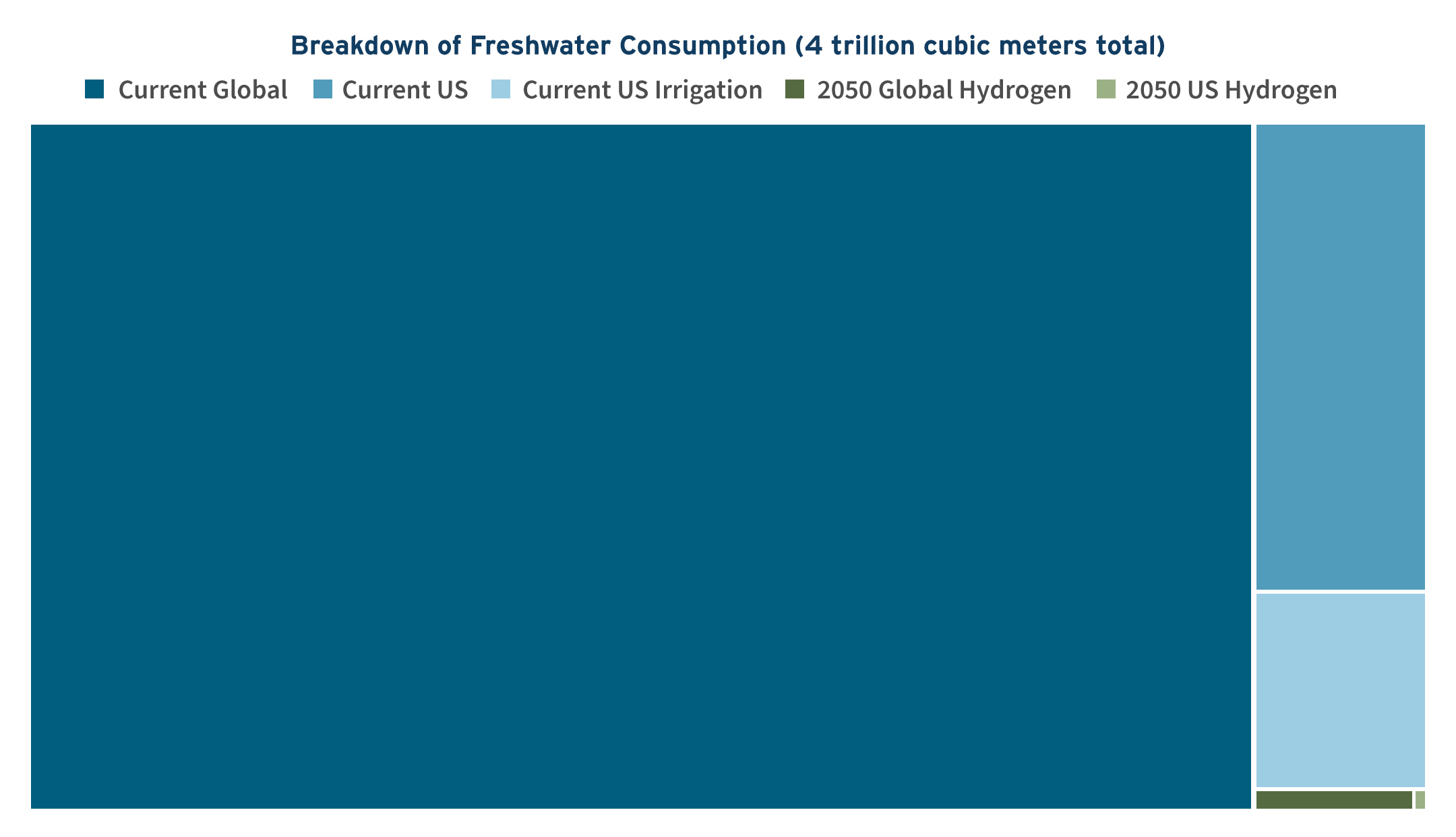
Exhibit 5: US Green hydrogen production in 2050 is projected to consume far less water than other large-scale consumers already do today, including agriculture and thermoelectric power production. Sources: energypost.eu; “Global scenarios for significant water use reduction in thermal power plants based on cooling water demand estimation using satellite imagery”; USGS; PRB.
Although on a global scale green hydrogen’s water needs are small, it is critical to ensure green hydrogen does not strain local freshwater resources. Hydrogen developers should prioritize efficient process design and consider local water availability in project siting. In areas of water scarcity, consideration of alternative sources such as treated wastewater or desalinated sea water will minimize freshwater reliance.
The choice of green hydrogen will consume no more water than its fossil-based “blue” hydrogen alternatives, and sometimes even less. Green hydrogen requires a cumulative 20–30 L/kg of water, and blue hydrogen requires 32–39 L/kg of water. Put in context with other large-scale water consuming processes used today, to produce the same amount of energy green hydrogen production consumes less than half the water of typical coal or nuclear electricity production.
With careful siting, planning, and operational considerations for local water management, green hydrogen projects can minimize total freshwater reliance and have a net positive impact on the surrounding region.
Learn More About H2
These websites provide comprehensive insights and information on hydrogen energy and its transformative potential: